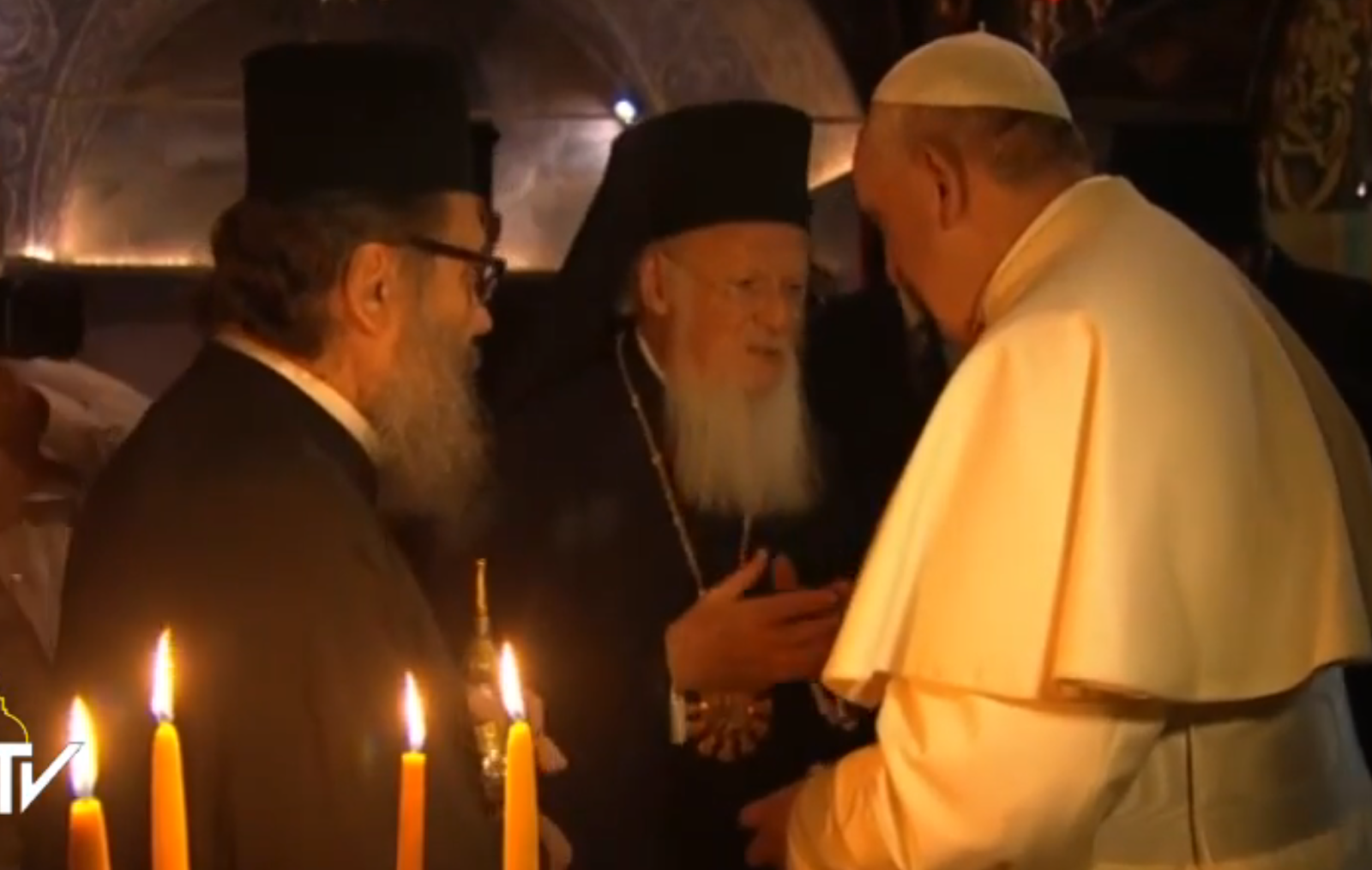
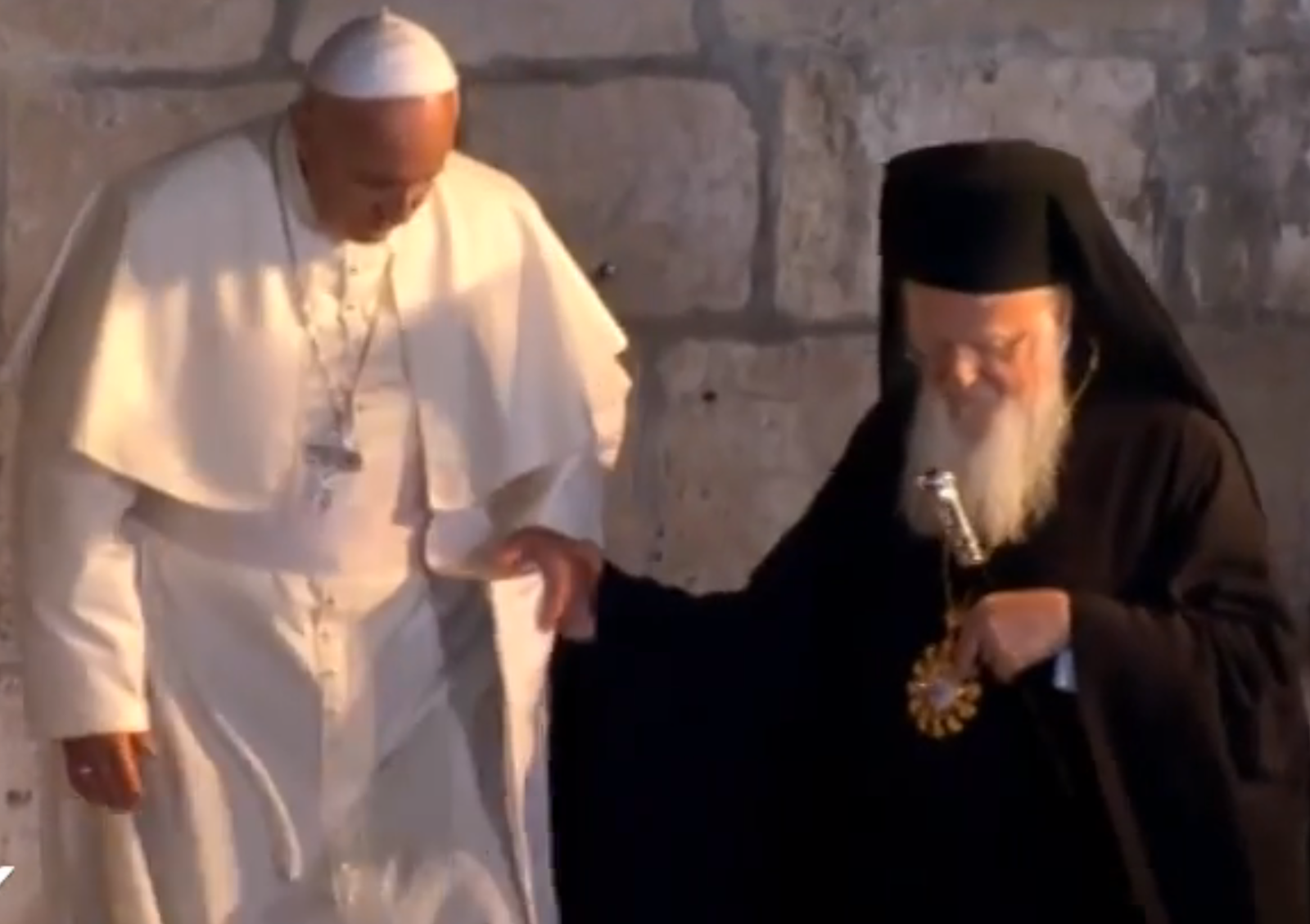
It was something of a blast from the past to see this pastoral staff, which I thought had been relegated to some store-room in the Vatican. It belonged first to Pope Paul VI. and was used by his successors until Pope Benedict changed it for another. Historically, Popes never carried croziers, and only occasionally a triple-barred cross; no doubt Paul VI felt the lack of something in his hand. Neither the cross of Paul VI nor that of Benedict were historical: I'd prefer if both were quietly dropped.
The occasion for this cross's sudden reappearance was the dedication of a large slab of the square outside the basilica of St John Lateran to the memory of Papa Wojtyla; no doubt its use suggested itself to Papa Bergoglio as being appropriate for the occasion.
Valle Adurni
Monday, 8 April 2013
Saturday, 6 April 2013
A Patron Saint for drug addicts?
I have been carefully trawling through the Martyrology recently—well, the night life scene in the Valle Adurni isn't exactly hopping—and, in the entry for 7th July have come across one Saint Mark Ji Tianxiang. He lived in a town that the Martyrology optimistically renders as Ueihœivénse in the Hebei province of China and, though Catholic, he was prohibited from the sacraments for thirty years on account of his unbreakable addiction to opium. He perished with many others in 1900 as a result of the Boxer rebellion; given a chance to renounce his faith and live, he refused and was duly martyred. Having been excluded from the table of the Lord on earth, the Martyrology points out, he was thus found worthy of the eternal banquet.
Saint Mark Ji, pray for all those who are held in the bonds of addiction.
Thursday, 4 April 2013
Officially even commoner than a pleb
I took the BBC's 'how posh are you?' test and have discovered that I belong to a class of people which is so plebbish that I never knew it existed. Even chavs decline to leave their cards at my home! Apparently I belong to something known as the 'Precariat' because I have a low income and do not own my home (the only options according to the BBC are to own or rent, so I selected rent; in fact, I am a tenant); I also know, like, and frequently associate with a lot of people the BBC presumably considers very common plebs.
Who drew up this thing? I've no problem with being a member of this Precariat (apparently representing the absolute dregs of society), but somehow I feel that it doesn't quite identify a lot of other characteristics which might be important. Yes, I know and associate with cleaners, manual workers and others, but I also would count some posh people among my friends.
Sometimes I think that the perceived class-ridden nature of UK society is a nonsense. At other times I'm not so sure. I'm especially intrigued that the (supposedly egalitarian) BBC seem to think it needs highlighting.
Who drew up this thing? I've no problem with being a member of this Precariat (apparently representing the absolute dregs of society), but somehow I feel that it doesn't quite identify a lot of other characteristics which might be important. Yes, I know and associate with cleaners, manual workers and others, but I also would count some posh people among my friends.
Sometimes I think that the perceived class-ridden nature of UK society is a nonsense. At other times I'm not so sure. I'm especially intrigued that the (supposedly egalitarian) BBC seem to think it needs highlighting.
Saturday, 30 March 2013
Monday, 25 March 2013
Chilean Priorities
The First Lady of Chile, Señora Piñera, meets our new Holy Father. And while you're here, Holy Father, would you mind………
I've got a parishioner just like this. She brings me bucketloads literally bucketloads of miraculous medals and rosaries for blessing every couple of weeks.
It's wonderful to see a faith-full First Lady.
I've got a parishioner just like this. She brings me bucketloads literally bucketloads of miraculous medals and rosaries for blessing every couple of weeks.
It's wonderful to see a faith-full First Lady.
A reassuring Palm Sunday
Yesterday, being a fourth Sunday of the month, we had our Extraordinary Form Mass in Steyning. Afterwards, outside, there was a little (it was very cold!) discussion about our new Holy Father: we all agreed that we felt very positive about him.
This seems to be the general opinion. On all the important things, we think he will be solid. He does not appear to be a theological tinkerer, or to want to turn the liturgical clock back to 1970, but he does seem to be addressing some other issues that are really important for the faith, not least charity.
I have seen around on the net opinions suggesting that he might sell off some of the Church's worldly treasures. I'm not so sure that disposing of patrimony is a completely good idea, but I wouldn't shed any tears. St Ambrose was very clear that when people are starving even the chalices should be melted down. And it would do a great deal of good for the credibility of our message.
One person yesterday commented that Pope John Paul had taught us to hope, Pope Benedict taught us to think, and perhaps Pope Francis will teach us to love.
Here are a couple of photographs of yesterday's celebration in St Peter's Square. I call them very reassuring.
These pictures are copyright, belonging to Fotografia Felici, so I hope the good Signori won't mind me giving their excellent service a little advertisement by putting screenshots of the pics here. Needless to say, I will remove them if required.
This seems to be the general opinion. On all the important things, we think he will be solid. He does not appear to be a theological tinkerer, or to want to turn the liturgical clock back to 1970, but he does seem to be addressing some other issues that are really important for the faith, not least charity.
I have seen around on the net opinions suggesting that he might sell off some of the Church's worldly treasures. I'm not so sure that disposing of patrimony is a completely good idea, but I wouldn't shed any tears. St Ambrose was very clear that when people are starving even the chalices should be melted down. And it would do a great deal of good for the credibility of our message.
One person yesterday commented that Pope John Paul had taught us to hope, Pope Benedict taught us to think, and perhaps Pope Francis will teach us to love.
Here are a couple of photographs of yesterday's celebration in St Peter's Square. I call them very reassuring.
These pictures are copyright, belonging to Fotografia Felici, so I hope the good Signori won't mind me giving their excellent service a little advertisement by putting screenshots of the pics here. Needless to say, I will remove them if required.
Monday, 18 March 2013
Stop the snarking!
Yes, yes, yes, I get it, and I feel it too. He isn't Pope Benedict, and I badly miss the Pope Emeritus. But everyone has strong points and weak points, and surely Pope Francis must be given a chance to contribute his many gifts? I am quite upset at the snarky comments circulating around, especially from those who should know better. Do people think that by undermining the Holy Father, by stirring up bad feeling, they are somehow helping the situation, or are they hoping for a recount of the votes in the conclave? Whatever happens, he will be our principle of unity for the next several years; so let's be unified, and back the man until (highly unlikely) he does something that we cannot back. I hate this backstabbing just in case, finding fault and almost hoping for the man to put a foot wrong just to prove us right.
Remember, grace builds on nature; the Holy Father is a man of his generation; that does not make him a heretic, though it might colour his expressions of the faith. Had I been a Jesuit ordained in 1969, no doubt I would have looked at the Church and the world differently. Things will look very different again to a Holy Father ordained in, say, 2000.
And secondly, I personally would not like to be judged on every ill-considered remark I have made in the course of my life. No doubt I have made lots. Pope Francis needs to be judged on what he does as Pope Francis, not on the things he might or might not have said to his mates in Argentina over a couple of beers, when such comments did not matter so much. That they retell them now says more about them than about the Holy Father.
He seems to be making the New Evangelization his priority. And, looking around me, I can't see a stronger need.
Remember, grace builds on nature; the Holy Father is a man of his generation; that does not make him a heretic, though it might colour his expressions of the faith. Had I been a Jesuit ordained in 1969, no doubt I would have looked at the Church and the world differently. Things will look very different again to a Holy Father ordained in, say, 2000.
And secondly, I personally would not like to be judged on every ill-considered remark I have made in the course of my life. No doubt I have made lots. Pope Francis needs to be judged on what he does as Pope Francis, not on the things he might or might not have said to his mates in Argentina over a couple of beers, when such comments did not matter so much. That they retell them now says more about them than about the Holy Father.
He seems to be making the New Evangelization his priority. And, looking around me, I can't see a stronger need.
Sunday, 17 March 2013
A couple of thoughtful posts on our new Holy Father
![]() |
| H/T Pittsburgh Post |
and, in his inimitable way, Eccles.
and Fr Zee, here.
We really need to get over the idea that all you need to to solve the Church's problems is to swing a thurible or sing an antiphon in Gregorian chant. Or, on the other hand, that if we do good works we have no need or use for orthodoxy or decent liturgy. Good liturgy, solid doctrine and lively, real, charity are all things that go to make up our faith. It is lamentable that some who hold one must needs despise others.
Have a look at the menu for the Holy Father's coming plumbing-in on Tuesday. To my mind it is one of the finest Papal liturgies that has been planned in recent decades. Thanks to Mgr Marini and Pope Benedict, of course, but I have no doubt that Pope Francis would have tinkered with it if he had wanted to. In fact, I think that he has; there are no chant responses for the Preface. If the Holy Father does not sing, it is probably because he cannot, and is someone who knows he cannot. Too many people who can't sing think they can and thus penance the rest of us. And if he struggles with the Latin, that's probably because he has almost never used it. But it doesn't mean that he won't do his best now that he is the supreme pastor of the Universal Church. I'm sure he will already have a least a reading knowledge of it.
Yes, I'd be happier if he felt as easy as Pope Benedict did in a fanon. But I already like the fact that he talks a lot about Jesus, without whom fanons would be pretty redundant.
In summa: oremus pro Pontifice nostro Francisco.
Thursday, 14 March 2013
And what now?
![]() |
| Pope Pius XI |
![]() |
| Pope Francis |
And those opening words; 'Buona sera', the equivalent of 'Hello'. Bathos indeed, after all the fuss. And then he just stood there, with barely a wave, looking a bit like a rabbit in the headlights. Time will show whether this was simply sheer fright or part of his calm, unhistrionic, style.
I was rather impressed with his words, if only because they were so artless. This was not a man who had memorised his acceptance speech, like a luvvie at the Oscars. The words came from the heart, and this made up for what he lacked in eloquence. Asking that people pray with and for him was a genuine good idea —meaning both genuine and good. And a good beginning, especially as there was no extempore ramblings, but simply the traditional Our Father and Hail Mary. I would have been happier had these been in Latin, but he was, I think, stressing that he is first and foremost the Bishop of Rome. Indeed, he used no other title.
Back home in Argentina he would appear to be a controversial figure. Many love him for his unfeigned charity, some (especially both the Kirchners) detest him for his firm stand on Catholic teaching. I gather that many of his Jesuit brothers are not keen on him, firstly for the firm way he administered their province when he was in charge, secondly for his refusal to support Liberation Theology, which some of them interpreted as support for an oppressive military dictatorship.
Somebody in the UK is bound to spot soon that he has spoken in favour of Argentina's claim to the Falkland Islands—but then he is Argentinian, and perhaps this is to be expected. And perhaps if asked he might say that indeed the Malvinas should be 'returned' to Argentina, but when Patagonia is given back its independence, and the lands taken from Chile and Uruguay returned. For now, I noticed that the BBC last night interpreted his taking of the name Francis as meaning that he was 'an animal lover.' Which tells you all you need to know about the BBC, anyway, but nothing about Pope Francis.
Some on the net have been horrid (really horrid—so horrid and uncharitable that I'm not posting links) about his lack of liturgical style. Yup, I don't imagine we will be seeing the return of the tiara any time soon. He's not a fan of the Extraordinary Form, but he does appear to be a genuine fan of Pope Benedict, so I don't think he'll be reversing any of his liturgical decrees. Just don't expect red shoes or white Paschal mozzettas. Still less a deal with the Society of St Pius X.
As for what everyone seems to think necessary, will he reform the Curia? Reform of the Curia is something that has been a kind of a mantra since the 1960s. The 'Vatileaks' scandal has suggested very powerfully that now something badly needs to be done; it may well have been the event that precipitated the resignation of Pope Benedict. Pope Francis is not a curial insider, but he has served on several Curial commissions as Cardinal and showed himself an able leader of one of the Synods in, I think, 2001. His time as Jesuit Provincial has showed that he is no push-over and, while unquestionably kindly, he is capable of firm, though unshowy, action. If I had to guess, I would say that there will be no heads rolling, but we should expect a gradual clear-out over the next five years or so. Even if what has come to be known as the Sodano party is right in thinking that little needs to be changed, the worldwide perception is that change is essential, and this is important for the credibility of the Holy See and the Church more widely. At the very least there needs to be a proper and transparent mechanism for dealing with the abuse cases around the world. As Tim Stanley wrote, the trouble is that the Curia function much like the Italian Government, and the Italian Government doesn't even work in Italy!
A friend on Facebook alerted me to this article from the Catholic Herald at the time of the last conclave; it is about the then second-placed Cardinal Bergoglio, and tells us more than most other sources.
Quiet thunder in Argentina
This profile of Cardinal Bergoglio first appeared in The Catholic Herald on October 7 2005
By JOSE MARIA POIRIER on Wednesday, 13 March 2013

Cardinal Jorge Mario Bergoglio of Buenos Aires (Photo: CNS)
José Mariá Poirier explains why the self-effacing Archbishop of Buenos Aires may well be the next pope
What a surprise: it turns out that the main opponent to the unstoppable Joseph Ratzinger in the April conclave was none other than the severe, shy figure of the Archbishop of Buenos Aires. The revelation comes in the “secret diary” of one of their colleagues in the Casa Santa Marta – a cardinal’s account of the election published recently in an Italian magazine.
The spotlight the news has placed on Cardinal Jorge Mario Bergoglio – whether or not it is true – will be agony for this notoriously media-shy Jesuit, whose face will have gone even redder with the speculation by vaticanisti that Bergoglio should now be seen as the leading contender to replace Benedict XVI when his time comes: the first Jesuit, and the first Latin American, in Church history to occupy the See of St Peter.
For Bergoglio’s enemies, the revelation will come as no surprise. It only proves, they will say, what we thought all along: that behind all that humility what Bergoglio really cares about is ambition.
But for almost everyone else it does seem remarkable that a relatively obscure South American cardinal should have been an obstacle in the path of the great German theologian and former prefect of the Congregation for the Doctrine of the Faith. The “secret diary” suggests that Cardinal Carlo Maria Martini, the former Archbishop of Milan and the standard-bearer for the progressive cardinals, asked not to be taken into consideration for reasons of age and health. His votes (around 40, according to the diary) went instead to Bergoglio, who was seen as the best hope for those who wanted, for whatever reason, to stop Ratzinger. Although the Bergoglio vote was not enough to stop Ratzinger, it prevented the German sweeping the board in the first two rounds.
Bergoglio as Pope? Perhaps it is not so surprising. There was much talk, in John Paul II’s final years, that his successor should be a Latin American; the feeling was widespread that the continent’s hour was near. Bergoglio would be a safe bet: at 69 he is relatively young, and comes with many virtues: he is austere, doctrinally solid, and with a proven track record in Church governance, as Jesuit provincial, then auxiliary bishop and Cardinal Archbishop of Buenos Aires.
Bergoglio’s star shone in Rome when he replaced Cardinal Edward Egan as relator for the September 2001 synod after the Archbishop of New York had to dash back to his traumatised city. The Argentinian moved easily and with great confidence into the role, leaving a favourable impression as a man open to communion and dialogue.
But there is little else in public view, the modest glimpses of Bergoglio only serving to heighten his enigmatic profile. The newspapers have rightly stressed that he is modest, dressing mostly as a simple priest; that he always travels on the bus or metro rather than by taxi or with a chauffeur; and that he regularly travels to the furthest ends of his three million-strong diocese, preferably to visit the poor.
And then, of course, there is that Trappist silence. His press secretary, a young priest, spends his time interpreting what the Cardinal does not say. The other part of his job is to turn down, on Bergoglio’s behalf, interviews or invitations to write articles. The Archbishop of Buenos Aires has almost no published work, and seems to become less visible with each passing year.
When he does speak, however – in the annual Te Deums preached from the cathedral – it is dramatic. Bergoglio thunders like an Old Testament prophet; the government quakes in its boots.
What is certain is that he is not loved by most of his Jesuit companions. They remember him as their provincial during the violence of the 1970s, when the army came to power amid a breakdown in the political system after the death of General Peron. Apart of the Church in Argentina was involved in the theology of liberation and opposed the military government. Bergoglio was not. “After a war,” he was heard to say, “you have to act firmly.”
He exercised his authority as provincial with an iron fist, calmly demanding strict obedience and clamping down on critical voices. Many Jesuits complained that he considered himself the sole interpreter of St Ignatius of Loyola, and to this day speak of him warily.
The secular clergy of his diocese, however, love their archbishop. As auxiliary bishop in Buenos Aires in the 1990s, he managed always to be with his priests, keeping them company through crises and difficulties and showing his great capacity for listening sympathetically (I have heard many stories of Bergoglio spending hours with elderly sick priests.) He also continued to show his option for the poor by encouraging priests to step out into the deep in intellectual and artistic areas: Bergoglio has never hidden a passion for literature.
Ironically, it is the same Bergoglio who, as Jesuit provincial, demanded absolute obedience and political neutrality, as the Archbishop of Buenos Aires wants his priests to be “out on the frontiers”, as he puts
Cardinal Bergoglio regularly travels to the furthest ends of his three million-strong diocese to visit the poor
it. He wants them in the neediest barrios, in the hospitals accompanying Aids sufferers, in the popular kitchens for children.
To take one example: when, last year, a number of young people died in a fire in a rock club tragedy, Bergoglio went to their aid in the middle of the night, arriving before the police and fire service, and long before the city authorities. Since the tragedy, one of his auxiliaries has a ministry to the family and friends of the victims, and has not been backward in criticising the government for its response to the tragedy.
Bergoglio is admired as being far from the powers of this world, indifferent to his media image, preoccupied by
the future of society, and a man looking always for new forms of social solidarity and justice in a country where 15 per cent are unemployed and thousands rummage through the bins at night looking for something to eat.
The media do not punish him for his silence, but speak of him with awe and respect. Many, including agnostic critics of the Church, regard him as the most credible social leader in a country in which, it ought to be said, politicians, union leaders and businessmen are regarded with considerable scepticism.
Where do his political sympathies lie? Certainly not on the Left. Those who know him best would consider him on the moderate Right, close to that strand of popular
Peronism which is hostile to liberal capitalism. In the economic crisis of 2001-2002, when Argentina defaulted on its debt, people came out on to the streets and supermarkets were looted, Bergoglio was quick to denounce the neo-liberal banking system which had left Argentina with an unpayable debt.
The same people who would say he was apolitical would be quick to add that he can move pieces along with the best chess-player. Soon after his appointment to lead his diocese he appointed six new auxiliary bishops, all people well-known to him and loyal. His style of government is discreet, but decisive.
A chemist by training, born to a working family of
Italian origin in a traditional middle-class quarter of Buenos Aires, he was for many years in charge of the formation of young Jesuits.
He is without doubt the strong man of the Argentinian Church, almost certain to be elected president of the bishops’conference at its next meeting.
With his suave manners and gentle voice, Bergoglio is not a theologian or an outstanding intellectual nor a polyglot (although he can cope with foreign languages), but he moves in all milieux securely and ably, especially in Rome.
Whenever I have met him, I have been struck by his astonishing paucity of words – even more remarkable in an Argentinian – and his hieratic gestures, but also by his intelligent gaze, his obvious spirituality, and his constant preoccupation with the poor.
If he were Pope? Everything suggests that his approach would be above all pastoral, which is what a number of the cardinals were looking for in the conclave. He would govern the Curia with a sure hand, as he does his diocese. He would likely take a firm stand with the powerful of this world. But the modern-day media demands on the papacy would be a torture for this most retiring of Church leaders.
José Mariá Poirier is editor of the Argentinian Catholic magazine Criterio
Wednesday, 13 March 2013
And as we await the name…
The Vatican Website has already updated!
vatican.va
If you watch it via the Vatican website, you won't get all those straplines that the other sites have.
vatican.va
If you watch it via the Vatican website, you won't get all those straplines that the other sites have.
Perch
This seagull has a taste for publicity, I think. Of all the chimneys in the world to choose……
Or perhaps he is carrying a secret listening device.
Tuesday, 12 March 2013
Tuesday, 5 March 2013
A Question
For my priest brothers...
I have in the last couple of days assisted some souls preparing for eternity, and have given the Apostolic Pardon as usual, besides Viaticum (this being a rarer privilege in these days of sedated death) and Extreme Unction (in these particular cases the term being indisputably appropriate).
Was I correct in giving the Pardon despite the Church being without a Pope?
I have in the last couple of days assisted some souls preparing for eternity, and have given the Apostolic Pardon as usual, besides Viaticum (this being a rarer privilege in these days of sedated death) and Extreme Unction (in these particular cases the term being indisputably appropriate).
Was I correct in giving the Pardon despite the Church being without a Pope?
Friday, 1 March 2013
And now we pray
Well, the Church of God moves on, and if yesterday was a sad one, today we pick ourselves up and look to the future. We all know that the new Holy Father will need to be a man of special gifts, and so we must all pray. I commend to you the project of Adopt a Cardinal, which I learnt about via Mulier Fortis. You go to the site, give your name and an email address, and in return you are given the name of one of the eligible cardinals, for whom you undertake to pray until the election. It's not a sweepstake, of course, a question of 'picking the winner', but praying that this man will be inspired now and in the conclave to elect a truly wonderful successor to St Peter and Pope Benedict.
I was allotted Cardinal Lluís Martinez Sistach, the Archbishop of Barcelona (see photo). Until today I have known nothing about him, but I will pray daily for him from now on. And I'm very taken with his funky biretta (which may have more to his doctorate in law than his ecclesiastical eminence).
So do go on over to Adopt a Cardinal and get one for yourself. There are already 143395 adopters, and rising!
I was allotted Cardinal Lluís Martinez Sistach, the Archbishop of Barcelona (see photo). Until today I have known nothing about him, but I will pray daily for him from now on. And I'm very taken with his funky biretta (which may have more to his doctorate in law than his ecclesiastical eminence).
So do go on over to Adopt a Cardinal and get one for yourself. There are already 143395 adopters, and rising!
Saturday, 23 February 2013
A married priesthood?
As the old Irishwoman said in disgust, seeing the Anglo-Catholic priest on the other side of the road; 'Calls himself a Father, and him with a wife and four children!'
Well, what a lot of fuss. I suppose I was naïve to have thought that the reign of Pope Benedict would, besides having set the barque of Peter on a more steady course, have done more to quiet those who would see it return to a more 'liberal' point of view.
We have seen two prominent Catholics recently express their support for a married priesthood in the Church—one not to be surprised at, Catherine Pepinster, the Editrix of the Tablet, but the other nothing less than a prince of the Church, Cardinal O'Brien.
We're not talking doctrine here: wishing for a married priesthood is not heresy. Indeed, some of the most orthodox of clergy, such as Fr John Hunwicke, have argued in its favour, at least for the Ordinariate. So I wonder why there has been such a reaction. Perhaps it is simply a collective groan of 'oh for heaven's sake; I thought we were beyond all that now!', not a million miles from my own thoughts.
I can't lose much sleep about Ms Pepinster's and the Cardinal's comments, unlike some others on the net. But I do not agree with these critics of celibacy, and thought that I would look at some of their arguments in favour and see what they amount to.
1. They say that it was the ancient practice to have a married clergy.
Let us be clear from the beginning that what people like Ms Pepinster and the Cardinal are asking for is not just a married clergy, but a co-habiting clergy. That sounds like stating the bleeding obvious, but it isn't, really. For the major part of the first millennium, priests might well have been married, but the custom was for them, once ordained, to sleep apart from their wives, while continuing to be responsible for them and their children. To cut a long story short, men would marry relatively young in those days—by 16 or so—have some children and then seek major orders, upon which they would separate from their wives. In the East this developed into a fully cohabiting clerical body, while in the West it developed into full celibacy. Marriage after orders has never been practised in the Church.
2. They say that St Peter was married.
Yes; at some stage he certainly had had a wife (because he had a mother-in-law), but there is no evidence that she still lived at the time of his calling. Another very early source (St Papias) tells us that the Apostle St Philip lived in his old age in Hierapolis (modern Pammukale) with his daughters—in this case, too, there is no evidence of a living wife.
3. They say that it will solve the vocations deficit.
I suppose that it is possible that a married priesthood might go some way towards helping this problem. But it isn't as easy as that; there are too many other difficulties to solve, not least the question of money. I heard tell recently of a (married) Anglican priest desiring to convert. He approached his local Catholic bishop and was warmly welcomed, but told that parish ministry would not be possible, because all the parishes that could support a married man were already taken by others. He will have to find a chaplaincy of some sort. Any married man would need an assurance of sufficient income to support his family (and just think how expensive children are these days!). Unless his wife was a serious earner, this would be a very difficult problem to solve unless the whole perception of giving were given a serious overhaul in our parishes—parting people from their cash is not fun.
Sometimes what is called the 'viri probati' argument is advanced; these are worthy men from the parishes ordained to administer the sacraments. I suppose these are what the Church of England would call non-stipendiary ministers. Here one runs up against the problem of training—something that would also apply to full-time married priests. Seminaries these days have great difficulty squashing all the courses they are required to teach into five or six years. But could the church support a married man and his family for all those five or six years? Okay, so we shorten the course, or make it part-time. Then we will get priests who are theologically unformed. I know of a 3-year course for the preparation of permanent deacons who, because of shortage of time, only study one Gospel. Yes, your eyes are not deceiving you; one Gospel only! And then people wonder why the homilies of some permanent deacons are not very good……! One might take the Greek system and ordain married men as, simply, sacrament dispensers; forbid them from hearing confessions or preaching. But does anyone think that this would be acceptable for long? The Church of England has begin ordaining non-stipendiary clergy on the basis of a two-year correspondence course; once ordained, many of these clergy may and do apply for stipendiary posts. It won't be long before they find out the problems of this one—the hard way.
4. Priests will more have more in common with their parishioners.
In an obvious way, of course that is true. But I'm not so sure that it is such a valuable point. After all there can be few who need sexual counselling these days, and I don't think that anyone would think of seeking that from a priest, either single or married. And as for family life; well, nearly all priests have been family members at some time or other. But it seems to me that what is needed these days is not more people having sex, but somebody who can stand aside from it and challenge the current world view that sex is the only non-negotiable right of all breathing beings; the most fundamental human right being to be free to have sex without responsibility. Celibacy challenges this, not least in the common assumption that priests must be getting it somewhere, surely, mustn't they?
No doubt there is more that could be said, (the argument from tradition, from the practice of our Lord, from the priest as Ikon of our Lord) and perhaps you might have some comments for the com box.
Well, what a lot of fuss. I suppose I was naïve to have thought that the reign of Pope Benedict would, besides having set the barque of Peter on a more steady course, have done more to quiet those who would see it return to a more 'liberal' point of view.
We have seen two prominent Catholics recently express their support for a married priesthood in the Church—one not to be surprised at, Catherine Pepinster, the Editrix of the Tablet, but the other nothing less than a prince of the Church, Cardinal O'Brien.
We're not talking doctrine here: wishing for a married priesthood is not heresy. Indeed, some of the most orthodox of clergy, such as Fr John Hunwicke, have argued in its favour, at least for the Ordinariate. So I wonder why there has been such a reaction. Perhaps it is simply a collective groan of 'oh for heaven's sake; I thought we were beyond all that now!', not a million miles from my own thoughts.
I can't lose much sleep about Ms Pepinster's and the Cardinal's comments, unlike some others on the net. But I do not agree with these critics of celibacy, and thought that I would look at some of their arguments in favour and see what they amount to.
1. They say that it was the ancient practice to have a married clergy.
Let us be clear from the beginning that what people like Ms Pepinster and the Cardinal are asking for is not just a married clergy, but a co-habiting clergy. That sounds like stating the bleeding obvious, but it isn't, really. For the major part of the first millennium, priests might well have been married, but the custom was for them, once ordained, to sleep apart from their wives, while continuing to be responsible for them and their children. To cut a long story short, men would marry relatively young in those days—by 16 or so—have some children and then seek major orders, upon which they would separate from their wives. In the East this developed into a fully cohabiting clerical body, while in the West it developed into full celibacy. Marriage after orders has never been practised in the Church.
2. They say that St Peter was married.
Yes; at some stage he certainly had had a wife (because he had a mother-in-law), but there is no evidence that she still lived at the time of his calling. Another very early source (St Papias) tells us that the Apostle St Philip lived in his old age in Hierapolis (modern Pammukale) with his daughters—in this case, too, there is no evidence of a living wife.
3. They say that it will solve the vocations deficit.
I suppose that it is possible that a married priesthood might go some way towards helping this problem. But it isn't as easy as that; there are too many other difficulties to solve, not least the question of money. I heard tell recently of a (married) Anglican priest desiring to convert. He approached his local Catholic bishop and was warmly welcomed, but told that parish ministry would not be possible, because all the parishes that could support a married man were already taken by others. He will have to find a chaplaincy of some sort. Any married man would need an assurance of sufficient income to support his family (and just think how expensive children are these days!). Unless his wife was a serious earner, this would be a very difficult problem to solve unless the whole perception of giving were given a serious overhaul in our parishes—parting people from their cash is not fun.
Sometimes what is called the 'viri probati' argument is advanced; these are worthy men from the parishes ordained to administer the sacraments. I suppose these are what the Church of England would call non-stipendiary ministers. Here one runs up against the problem of training—something that would also apply to full-time married priests. Seminaries these days have great difficulty squashing all the courses they are required to teach into five or six years. But could the church support a married man and his family for all those five or six years? Okay, so we shorten the course, or make it part-time. Then we will get priests who are theologically unformed. I know of a 3-year course for the preparation of permanent deacons who, because of shortage of time, only study one Gospel. Yes, your eyes are not deceiving you; one Gospel only! And then people wonder why the homilies of some permanent deacons are not very good……! One might take the Greek system and ordain married men as, simply, sacrament dispensers; forbid them from hearing confessions or preaching. But does anyone think that this would be acceptable for long? The Church of England has begin ordaining non-stipendiary clergy on the basis of a two-year correspondence course; once ordained, many of these clergy may and do apply for stipendiary posts. It won't be long before they find out the problems of this one—the hard way.
4. Priests will more have more in common with their parishioners.
In an obvious way, of course that is true. But I'm not so sure that it is such a valuable point. After all there can be few who need sexual counselling these days, and I don't think that anyone would think of seeking that from a priest, either single or married. And as for family life; well, nearly all priests have been family members at some time or other. But it seems to me that what is needed these days is not more people having sex, but somebody who can stand aside from it and challenge the current world view that sex is the only non-negotiable right of all breathing beings; the most fundamental human right being to be free to have sex without responsibility. Celibacy challenges this, not least in the common assumption that priests must be getting it somewhere, surely, mustn't they?
No doubt there is more that could be said, (the argument from tradition, from the practice of our Lord, from the priest as Ikon of our Lord) and perhaps you might have some comments for the com box.
Sunday, 17 February 2013
All change
I have been quite astonished at the world's interest at the abdication of Pope Benedict. When Rowan Williams announced his retirement there was some polite notice taken, but it tended to be of the five-minutes-second-item sort on the main television news. Tim Stanley has written a post on the subject which has deservedly attracted much attention; he understandably expresses concern and annoyance at some journalists' efforts to dictate to the Church just what sort of Pope ought to be elected. They wouldn't do this to other faiths, he says.
And, of course, he is right. But it is interesting, isn't it, that somehow the world genuinely feels that it has some sort of a stake in the man who will become the next successor of St Peter? Gordon Brown, towards the end of his premiership (and possibly in an effort to curry favour with the Catholic vote) described the Catholic Church as the 'conscience of the nation' or something like that. This impression was reinforced at the visit of Pope Benedict in 2010; David Cameron said to the Holy Father that he had 'made us sit up and think'; I expect Mr Cameron did sit up and think—perhaps for as long as half an hour—before reverting to type. For some reason the world is mighty keen to bring the Catholic Church on side. Which I think we ought to take as (as Ronald Knox said of Arnold Lunn) 'a compliment of sorts, like the crocodile pursuing Captain Hook'.
What I am trying to say is that the walls of the ghetto have truly been torn down now, and this has both good and bad consequences. Walls make good protection; it is possible to escape notice entirely with a good wall around one. But walls also prevent any contact with people outside. Though not the case on the continent, the Church in this country had become very used to its walls and a near-complete separation of our faith from the doings of the world. Some might say that there was something Catharistic about it.
As I said, on the continent, it was not so; from the time of Clovis the French have had a very close, almost incestuous, relationship of throne and altar. Italy too has a long tradition of close engagement, which was what rendered the 'non expedit' of Pius IX and Leo XIII such a problem for the Italian state and paved the way for the Lateran Treaty of 1929. Other (though not all) states have had similar arrangements, though since the American and French revolutions there has been a growing tendency to desire a clear separation of Church and State, something very hard to achieve unless one is going to deprive every communicant of their citizenship, for members of churches also vote and pay taxes and therefore have a right to exercise as much influence on government as any secularist.
By the twentieth century, even in countries that engaged with government there was some sort of ghetto mentality. Perhaps this was partly due to the wave of revolutions in the mid to late nineteenth century, mostly of the socialist/masonic/agnostic type, which caused the Church to retreat from the modern world as from something which fundamentally threatened her existence. Perhaps it did and does. The Syllabus of Errors, even the Anti-Modernist Oath, reinforced this sense of suspicion of the modern world which, it seemed, would never understand unless it submitted to the grace of God.
Was this retreat from the world good? I think that as an unrepentant traddy I'm supposed to say yes. But I don't think I can entirely, because the world continued to develop in its own way, and that was increasingly at variance with the Christian foundations of those very societies themselves. The Church may have protected herself against the world, but at the same time she diminished her ability to influence that world for good.
Pope John XXIII, when a papal diplomat, engaged with a lot of people who were not religious, and found that generally they were nice people. But then he was the sort of person who got on with others anyway. And I think that he saw clearly that the Church was becoming increasingly meaningless to an awful lot of people: the book France; a Missionary Country? was published during his time as Nuncio in Paris. To him, perhaps the Church needed to come down off her dignity a bit and try to re-engage with a world that was rapidly becoming more and more secular.
To many this came as a great breath of fresh air. To others, it did not. As one priest put it to me, 'to "throw open the windows of the Church to the world and let in fresh air" implies that the air outside is better than the air inside!'
Vatican II firmly brought the walls tumbling down. The difficulty is that, precisely, it was the worldly media which interpreted Vatican II to the world. There were two councils; one of bishops in the aula, and the other, far more influential council, of 'experts' (ecclesiastically or self-appointed) and journalists in the bars outside. Inevitably, it is not the council documents that made the headlines, but the comments of the 'experts', who created the expectation of vast change that swept the Church. Bishops returned to their sees from the Council amazed to hear that they had voted for a completely vernacular Mass, for instance—as Cardinal Heenan commented, that wasn't what they thought they had done. But the newspapers had brought the news ahead of them, and created a climate of expectation of more and more radical change on just about every subject. The bishops simply had to get on board the bandwagon or be left standing.
Probably the most damaging thing was not the changes made to the liturgy, but what has been called the catechetical revolution. It robbed two generations (at least) of the ability to articulate and understand their faith. It took from them a standpoint from which to assess the assertions of the newspapers, and made them prey, like everyone else, to the murky world of 'feelings' without understanding. 'Securus judicat orbis terrarum' has always been a motto that made sense in the Catholic context—it was the thing that changed Newman's life. And now, having had the wind sown for us, we are reaping the whirlwind.
The walls of the ghetto are indeed down; Catholics have been permitted to rejoin the human race, but they have been deprived of the very means of preserving their faith against the world which is now staring in and making rude observations, long and loud, about what they see.
Siobhan McDonald MP (a practising Catholic) ridiculed Archbishop Peter Smith over his suggestion that people would leave the Church over this Gay Marriage thing. But the Archbishop was perfectly right; people have left, and continue to leave. I can think of three or four in this parish alone; one of them came to tell me, in a perfectly friendly but firm manner, that she was going, and why. There are probably many more of whom I am not aware. This is not entirely their fault; they have never been given the necessary information to help them make a proper assessment of the situation. I have tried, and continue to try, but all their mental formation has been in a secular context, and their religious formation has been so impoverished that I feel sometimes as if I am speaking Chinese to them. It isn't that they won't understand, they can't. To them, I, and the Church, are simply homophobic bigots and bullying autocrats without an ounce of compassion or genuine faith.
So what now? Yes, we are under fire, but I am not convinced that this is entirely a bad thing right now. The world continues to be intensely interested in the Catholic Church because, I think, it has a sneaking suspicion that we might be on to something. Otherwise it would dismiss us as irrelevant. It may call us irrelevant, but its actions belie this. As long as we continue to stand, if necessary to the last man, then we continue to preach the Gospel which challenges them, and some will listen.
And this is a challenge to us. We need to prepare our young people adequately for the road ahead. Finally, I think that this particular message is getting home; the years ahead will be interesting.
Tuesday, 12 February 2013
The Aftermath
Well, it has been astonishing, hasn't it? Yet again Pope Benedict takes the world by surprise. When the Archbishop of Canterbury retired there was a five minute slot on the BBC news; today there seems widespread amazement. I've just been to get my hair cut, and in the barber's shop the radio, a day after the announcement, was full of chatter about Pope Benedict and the succession. The man in the chair next to me started to go off on one about the Catholic Church, and how all priests were sex offenders; meanwhile the barber, who knew very well who I was, was desperately trying to head off the conversation without causing offence to either of us; in a way it was rather comic.
Then I went to the co-op to get some Shrovetide supplies, and saw the newspaper headlines. Most of them were respectful and interesting-looking, and the main cover story. But these two caught my eye (I had my iPhone handy):
I chuckled out loud at The Sun's dreadful Dun Roman pun, but noticed that Gazza's £40k takes pride of place. As for The Daily Star: well, the parish secretary (a devotee of fly-on-the-wall TV) told me that Speidi apparently is two people from Big Brother whom everybody knows–apart from me apparently. Which Speidi half the picture shows, I couldn't say. In her turn, she said that she had been listening to the Pope's brother; she asked me his name, so I said 'George'. 'No', she said, 'what's his other name.', 'Er, Ratzinger…'. 'No, no' she said'; that isn't the name'. 'Er…' I said again. 'I've got it' she replied, 'Lombardi'!
So it was one all: Speidi for her, and Ratzinger for me.
Then I went to the co-op to get some Shrovetide supplies, and saw the newspaper headlines. Most of them were respectful and interesting-looking, and the main cover story. But these two caught my eye (I had my iPhone handy):
I chuckled out loud at The Sun's dreadful Dun Roman pun, but noticed that Gazza's £40k takes pride of place. As for The Daily Star: well, the parish secretary (a devotee of fly-on-the-wall TV) told me that Speidi apparently is two people from Big Brother whom everybody knows–apart from me apparently. Which Speidi half the picture shows, I couldn't say. In her turn, she said that she had been listening to the Pope's brother; she asked me his name, so I said 'George'. 'No', she said, 'what's his other name.', 'Er, Ratzinger…'. 'No, no' she said'; that isn't the name'. 'Er…' I said again. 'I've got it' she replied, 'Lombardi'!
So it was one all: Speidi for her, and Ratzinger for me.
Monday, 11 February 2013
Thank you, Holy Father
When you were elected, I remarked several times to friends and colleagues that what we needed was 'eight good years'. I little thought then that my wishes would be fulfilled so closely. Thank you, Holy Father; I pray that your retirement will be everything you wish and need. May God reward you for the extraordinary things you have achieved in these eight wonderful years.
And may God grant the increase!
Sunday, 3 February 2013
A Visit
A lovely occasion today: six students from St John's Seminary at Wonersh came today to assist at Mass in Steyning: it was simply a free weekend for them, and I was delighted that they decided to spend the day in the Valle Adurni—though its beauties were not really at their best today, on account of the miserable weather.
It was a rare opportunity for me to be able to connect two important but distinct parts of my work. And I think that our parishioners were edified to see a bunch of splendid young men giving their lives to God.
A letter
The Valle Adurni parish is itself rather a strange marriage of two very different communities with two very different sets of needs. It has two different telephone exchanges, which means that a lot of the calls one makes have long numbers to dial, it has two different local councils with different sets of rules about what, for instance, can go into the recycling bin. The communities really ought to be in two different counties, too, but fortunately aren't. And I could go on.
In the very first parliament, what is now this parish sent no fewer than six men to Westminster. Nowadays, we have to make do with two: Shoreham has Tim Loughton, and Steyning has Nick Herbert. And, as you would expect, these two MPs are very different, not least on the forthcoming debate about so-called 'gay marriage'. I understand that Nick Herbert is in fact in a civil partnership.
Tim Loughton was kind enough to write us a letter a few days ago, which I distributed to all the parishioners in Shoreham, and offered copies to those in Steyning. I asked him whether I could post it here, and he kindly agreed.
In the very first parliament, what is now this parish sent no fewer than six men to Westminster. Nowadays, we have to make do with two: Shoreham has Tim Loughton, and Steyning has Nick Herbert. And, as you would expect, these two MPs are very different, not least on the forthcoming debate about so-called 'gay marriage'. I understand that Nick Herbert is in fact in a civil partnership.
Tim Loughton was kind enough to write us a letter a few days ago, which I distributed to all the parishioners in Shoreham, and offered copies to those in Steyning. I asked him whether I could post it here, and he kindly agreed.
I thought it might be helpful if I wrote an open letter to you and your congregation about the forthcoming Parliamentary vote on proposals for 'gay marriage.' This is a subject which I know to be of particular interest to my churchgoing constituents many hundreds of whom have already written to me individually. Please use or distribute this letter as you best see fit, which is based on my views which have been publicised on my own website for some time.
It is particularly gratifying to see the personal testimonies that many constituents have written to impress upon me why they take a particular viewpoint, rather than having simply forwarded on a pre-prepared text. That is all the more appropriate because the issue of 'gay marriage' should be a matter of personal conscience, rather than of party political line or institutionalised agenda. The Prime Minister has clearly set out his reasons for being in favour of 'gay marriage' and I respect his right to do so. But, I particulaily respect his acknowledgement that this should be a matter of personal beliefs and that Conservatíve MPs at least will be free to make up their own minds.
As such, I have to say that my instinct has for some time now been not to support these proposals and, as it stands, I intend to vote against measures to legalise gay marriage. It is likely that this opportunity will first come before the House of Commons on February 5th though that is subject to change. However, it is right that we should take soundings from our constituents on this sensitive issue and I certainly welcome your representations, as I will any other constituent with whatever viewpoint.
In coming to this view, it in no way diminishes my passionate support for sexual equality and that everyone of whatever sexuality should have equal opportunities and rights in our society. That is why I enthusiastically supported the creation of civil partnerships which put gay couples on an absolute equal footing with heterosexual couples in the eyes of the law. I believe that was, and remains, the right thing to do although some people may still take a different view. What has particularly annoyed me in this whole debate, is the tendency for certain elements of the lobby in favour of 'gay marriage', instantly to caricature anyone who is against, as homophobic. That is grossly unfair, misleading and does nothing to promote their case, let alone a grown-up debate about what is a very sensitive and personal subject. In my case, certainly nothing could be further from the truth and previously as Minister for Children & Young People I particularly valued the work I did with LGBT young people and community groups.
From my personal perspectíve, when I entered into a Church of England marriage with my wife 20 years ago 'ast July, and with my father presiding as the local rector, it was a
tremendously special and solemn occasion. It was characterised by the part of the Church of England marriage service which defines marriage as:
'a gift of God in creation through which husband and wife may know the grace of God. It is given as the foundation of family life in which children are born and nurtured.'
I hope you will see, therefore, why it ís diffícult for me to accept that the solemnity of marriage as a religious institution can be anything other than between a man and a woman, and particularly where all the rights and responsibilities of marriage are now available to non-heterosexual couples through civil partnerships. I do not see why we need to change the law and I also do not see why we need to change the law at this time when there are so many other important matters for the Government to be addressing, not least on the need to restore our economic fortunes.
I am also concerned that despite assurances given by the Government that the change in the law proposed will not be the end of the story. Given recent rulings in the European Court of Human Rights regarding the wearing of religious symbols and the sacking of those who feel unable to counsel same sex couples on matters of 'conscientious objection', I cannot believe that the law will not be challenged there and the prerogative of churches to be exempted will be undermined. There are also many practical considerations around how 'gay marriages' can be annulled and what will be the obligations of churches renting out church property etc. All in all this is a move which I believe will become a legal minefield.
However, my position, which has not been taken lightly, does not preclude me from listening closely to the many different representations that I am sure will continue to be made to me. I therefore welcome any questions or comments from constituents through the normal channels which can be found on my website and this will certainly help better to inform my contributions to the Parliamentary scrutiny of the legislation.
Thank you for passing on the contents of this letter and I am particularly grateful for the many people who have already offered their prayers for my deliberations in this issue.
Wednesday, 16 January 2013
The bells, the bells……
![]() |
| The bells being removed last 20th February. Photo: Delphine Goldszteijn, PhotoPQR,Le Parisien |
So the decision was made to replace them with some new, more euphonic, bells in time for the 850th anniversary of Notre Dame this year. Therefore, last February, the four bells were removed from the towers and sent to the bell-founders in Normandy to be melted down. The idea was to cast little model bells from them which could be sold to defray the cost of the new peal.
The news of this reached the ears of the little community of Sainte-Croix de Riaumont in the Pas-de-Calais. They were shocked that this act of vandalism would be perpetrated, all the more so since they are building a new priory and are in need of bells themselves. Their prior, Fr Alain Hoquemiller, (whom I remember meeting a few times when he was studying for the priesthood at Fontgombault Abbey) has made an offer of at least 24.000 euros for the bells (he must have good sponsors!) which is generally considered to be in the right ball-park. But the Archdiocese of Paris has indignantly refused the offer and wants to proceed to the destruction of the bells.
This community of Sainte-Croix is a remarkable one; following the rule of St Benedict, they have developed their own version of the life out of the strange circumstances of their foundation. They began when a priest commenced work with the disadvantaged boys of the industrial Arras region of northern France—there was much poverty and hardship, with all the usual accompanying social disorders. This priest, whose name I forget, thought that the scouting movement provided a sort of ideal for boys to live up to, and, not finding the existing scouting movements quite focussed enough, founded his own denomination of scouts to help with his work. Over the years, it became extraordinarily successful. Not only would these boys be taught the usual scouting things, but they would be taught their faith, given the sacraments that they lacked, and provided with a secure home-from-home where they could find affection and stability and some good food. The local social authorities and judiciary noticed the excellent work being done, and began to send boys to Riaumont for help.
The trouble was that when these first boys grew up, they didn't want to leave. And so the religious community grew out of the scouts. A man called something like Argouac'h (a Breton) was their first ordained priest, and now they have a trickle of young vocations continuing and expanding this remarkable work. Scouting remains at the heart of what they do—even the religious habit is khaki.
So why is the Archdiocese of Paris so reluctant to support this excellent project? It's the old story: the community of Sainte-Croix de Riaumont celebrate the traditional Mass. Of course the Archdiocese don't say that, but they are absolutely adamant nonetheless that the bells shall not go to the community, but shall be melted down, and it seems hard to understand otherwise why. The manufacture of the little souvenir bells will cost some two million euros, apparently, without any prospect of buyers. Here they have a more than adequate offer which they are refusing.
And now the bells have gone to law. For the Archdiocese, the difficulty is that, in French law, the bells aren't actually theirs. By a law of 1905, external features of ecclesiastical structures belong to the state, not to the Church. So, Fr Alain acted correctly in approaching not the Diocesan authorities, but the Direction Régionale des Affaires Culturelles d'Ile de France, known as DRAC, who verbally accepted his offer for the bells in October. This has been contested by the Diocese, and until the dispute can be settled, the bells have had a 'do not touch' order slapped on them by the state.
And, as Fr Alain points out, a law of 15th July 2008 declares that anyone responsible for the destruction or even deterioration of historic religious objects faces seven years of imprisonment and a fine of 100.000 euros!
p.s. There's an online petition here to save the bells.
Monday, 14 January 2013
Steaming up the Valle Adurni
Until Mr Beeching had his wicked way, there was a railway line from Shoreham to Horsham, following the River Adur along much of its course: with a change at Christ's Hospital, you could travel on to Guildford, stopping at Bramley and Wonersh where our diocesan seminary is. How useful that would be to me today! Locals have told me that Beeching sent his ghouls out to inspect the traffic on the line during half term: the line was much used by school children, and it was these who principally suffered when the line closed. The timing of the inspection was considered to have been deliberate.
Anyway, do enjoy these short movies showing the line in action—quite a bit filmed in colour.
Saturday, 12 January 2013
The Lectionary again
I'm not really a fan of the Jerusalem Bible, in either of its incarnations (that is, the original Jerusalem Bible of the early 1960s and the reworking under the remarkably energetic Dom Henry Wansborough* in the 1980s). That being said, I think that, as in so many historical matters, context is everything.
Before the JB, in England and Wales there were really only two translations available to Catholics; the Douai-Rheims, which is so literal a translation (intended more for controversy, perhaps, than devotion) as to make it sometimes nearly incomprehensible; and the Knox version, produced in the 1940s, the work of one man. I very much appreciate Ronald Knox—I have two shelves of his books, (and am delighted to see that audible.co.uk has now issued his detective novels in unabridged audiobook form), but I can't warm to the Yoda-speak of his Bible translation: 'for the illumination greater of his auditors, backwards spoke he'.
The JB was intended to be some sort of breath of fresh air, and seen against the context of the Douai and the Knox, who can doubt that that was what it was. It intended simply and artlessly (I suppose) to set down simply what the things seems to say, in modern language, deliberately avoiding translations of certain verses which have passed into the language such as 'in my Father's house there are many mansions', or even 'I know that my Redeemer lives/liveth', in order to give the reader a fresh experience of the Word of God.
Instead of employing one translator or even a team, the English Jerusalem Bible project farmed different books out to different people. The result is very uneven, as one might expect. Some books are beautifully translated, others dreadfully. For me, though St Paul can be pretty awful at times, the worst seems to be the Gospel of St John; perhaps because we hear it at the key times of the liturgical year as, for instance, in the magnificent Johannine Prologue:
'Indeed, from his fulness we have, all of us, received—yes, grace in return for grace' Jn1:16
I'm not suggesting that the words can't mean that; apparently they can (though Fr Hunwicke would know best). But in cases like this I think a translator must ask himself not just what the words could possibly mean and then plump for the most unusual possible version just to give the passage 'freshness', but to ask himself what the author is actually saying. I do not think for a moment that the Evangelist is suggesting that God gives us grace in return for the grace we give Him (as if!). Charin anti charitos can also mean 'grace in exchange for grace', I am told, but surely it should be read 'grace upon grace' or 'grace after grace', and this indeed is just as accurate a way of rendering the Greek words, and a much more accurate way of rendering the theology.
The translation of the famous bit of Job 'I know that my Redeemer lives' as 'I know that my avenger lives' makes that glorious passage unusable at a funeral unless one is lucky enough to have access to an RSV lectionary (and the old RSV lectionary is notoriously difficult to drive, let alone find).
And what about that passage from John and Easter: 'I'm going fishing'; 'We'll come with you!'; Peter 'had practically nothing on'. And in the garden of Gethsemane: 'Who are you looking for?' I could go on and on. How about 'Jesus burst into tears' or 'and his hand was better'. Ouch, ouch, ouch! With our new Missal translation, these things seem more and more uncomfortable.
I spoke about this with a very senior cleric, and he seemed to think it likely that a new edition of the lectionary might well use the RSV, which I presume means what is sometimes called the Ignatius RSV; the second Catholic edition, that is. He seemed to think that the proposal to use the NRSV has now been shelved: I heard some time ago that it had been planned to have lectionaries out by now in this version, but the delay was on the part of the NRSV people, who objected to the Catholic Church tinkering with God's Word by adding the little incipits before, for instance, the Gospel readings at Mass; things like 'at that time, Jesus said to his disciples………'. As an Anglican friend pointed out, this is all the stranger, as they seemed perfectly happy with the much more extensive rewritings of the text for the Anglican lectionary. But then perhaps it was that experience that led them to forbid any alterations at all for the Catholic lectionary. Anyway, we can be grateful that at least we have been spared the NRSV. I shall be very content if we can have the RSV, and hopefully soon!
Note: Thanks to Joshua (see comments) for this link, confirming that we shall have an ESV lectionary soon. And thinking about it, I suspect that the bishop I was speaking to may well have said ESV, not RSV. But I think of ESV as being an improved RSV in any event—as long as important Catholic corrections are made, such as at the Angel's greeting; 'full of grace' rather than 'richly flavoured one' or whatever.
* At the time I was working in Oxford, Dom Henry was the Master of St Benet's Hall. He was notable, among other things, for the fact that he sped around Oxford on roller blades; he had mastered the art of travel, but had not yet worked out how to stop, and was therefore obliged to grab onto something—a lamp-post, a college, a senior don, that sort of thing— if stopping became necessary. In this way, he passed into student legend, though, which is notoriously unreliable. The same corpus of legends, I am told, still tells of the way I used to go running in the University Parks in green lycra. I have never knowingly worn lycra in my life (unless woven into something else, I suppose), though I did have a green Irish rugby shirt which I sometimes used.
Thursday, 10 January 2013
Don't worry; be happy
I want you to be happy, always happy in the Lord. I repeat; what I want is your happiness. Let your tolerance be evident to everyone; The Lord is very near.
A parishioner made reference to this recently, in criticism of the (extremely little) plainchant that we have introduced—in fact, only the Missal chants (and not the Gloria) in Advent and Lent. That, he said, is 'miserable', whereas the Bible says that the Lord wants us always to be happy; so why can't we have the 'clapping Gloria' all the time? Well it did no good to suggest that that that sort of thing was what made me miserable, or to point out that I have continually to sacrifice my taste so that he can have his—St Paul told us to be 'happy', and that is that.
The question is, did he? 'Being happy' and 'rejoicing' seem to me to be two rather different things. St Paul's letter to the Philippians is a great hymn of Christian rejoicing as the answer to current suffering—rejoicing (like loving) is something we do rather than something we feel; the feeling comes as a consequence of the action. One can make oneself happy with all sorts of things, but rejoicing is something far more precious.
And the reference to the nearness of the Lord rather has the sound of 'don't make a sound, because teacher's listening', rather than the confident hope of the coming Saviour (the thought comforting us in our tribulations) which suggests both the second coming and the approach of Christmas.
The shallow interpretations of 'love' and 'rejoicing' bring to mind that National Pastoral Congress mission statement;
We are the Easter people, and alleluia is our song.
I have always rather thought that it is more appropriate to consider ourselves the Parousia people and Maranatha be our song.
Which is why I much prefer the translation 'Rejoice in the Lord always; again I say rejoice! The Lord is at hand'.
We are the Easter people
Alleluia is our song
Make your request, we'll not refuse you
We are here just to amuse you
Would you like to share your story?
Will you share our joy?
At Sunday Mass we're more than keen
To jump around and make a scene
Although we all wear purple jeans
We're happy girls and boys.
Thursday, 13 December 2012
Pipians
The Holy Father using Twitter has brought a number of responses from the Blogosphere, not least Mulier Fortis' Habemus Tweet.I'm sure we can do better in Latin than 'tweet', though. My mind goes cranking back thirty years to reading Catullus about Lesbia's wretched dead sparrow*. There we find in Lugete, o Veneres Cupidinesque (poem 3)
…circumsiliens modo huc modo illucSo, pipiare is 'to tweet'.
ad solam dominam usque pipiabat.
Now someone who's Latin is better than mine ought to make a noun out of it. Pipia? So Habemus pipiam?
* and yes, I know it might mean something else, so don't bother posting rude comments.
Sunday, 9 December 2012
The stuff to give the er, prime minister
Bishop Joseph Devine is not a man to mince his words. He has written to the Prime Minister to tell him exactly what he thinks of him. Here's a taster:
'So where next for David Cameron’s spiritual mission?... While I cannot speak for other creeds, let me be quite frank with you. So far as the Roman Catholic Church...is concerned, you are out of your depth. We will take no finger-prodding lectures from anyone or any group devoid of moral competence.'
Wow! And there's lots more like it. The letter itself doesn't appear to be around on the internet, but there is an interesting discussion of it here on Archbishop Cranmer's blog. (H/t Simon Cotton).
Thank you, Bishop Devine. Keep it coming.
'So where next for David Cameron’s spiritual mission?... While I cannot speak for other creeds, let me be quite frank with you. So far as the Roman Catholic Church...is concerned, you are out of your depth. We will take no finger-prodding lectures from anyone or any group devoid of moral competence.'
Wow! And there's lots more like it. The letter itself doesn't appear to be around on the internet, but there is an interesting discussion of it here on Archbishop Cranmer's blog. (H/t Simon Cotton).
Thank you, Bishop Devine. Keep it coming.
Saturday, 8 December 2012
Old rite train
This is locomotive 34067 'Tangmere' crossing the River Adur at Shoreham at 9.20 this morning. A chilly morning, with the river at nearly low tide.

If you look at the movie full size, you should clearly see the neo-gothic Lancing College chapel and the much-filmed art-deco Shoreham Airport terminal building which often appears on period productions (often standing for Croydon Airport) and dramas, such as Poirot. At the end of the train is a diesel locomotive; not to push, but to provide heating for the carriages.
(okay, perhaps not so clear; the precision lost something in the uploading—you'll have to take my word for it!)
If you look at the movie full size, you should clearly see the neo-gothic Lancing College chapel and the much-filmed art-deco Shoreham Airport terminal building which often appears on period productions (often standing for Croydon Airport) and dramas, such as Poirot. At the end of the train is a diesel locomotive; not to push, but to provide heating for the carriages.
(okay, perhaps not so clear; the precision lost something in the uploading—you'll have to take my word for it!)
Monday, 3 December 2012
Thursday, 29 November 2012
Leo
I have decided to delete the post about the Society of Pope Leo XIII. The Society looked, and looks, to me to be a very strange organisation which has little or nothing to do with the Catholic Church. However, the comments in the combox were getting worryingly specific, and my policy of only excluding egregiously offensive comments was allowing through allegations which I was personally unable to prove or disprove, and therefore defend. I apologize to those who made comments; my suggestion is that if you feel strongly enough about these things, that you establish a blog to express them.
Saturday, 24 November 2012
Another new blog
Do go over and take a look at a new blog, written by my friend, the newly qualified Doctor Tommy Heyne, a graduate of the excellent University of Dallas, and which went on line only last night. His site—for though technically a blog it seems rather more like a website—is already a positive cornucopia of interesting things, mostly concerned with the spiritual, the medical and the missionary.It seems such a little time ago that I was beginning to despair that the Church would ever find her feet again—the grain had really fallen into the ground and appeared to die. But, as our Lord promised, green shoots are everywhere. In people like Dr Tommy, we can see the Church reaching out in a missionary sense, full of zeal for the Gospel, and also for the corporal works of mercy.
Dr Tommy's site is confusingly called Caritas, Veritas et Hilaritas—nothing to do with Fr John Boyle's excellent Caritas in Veritate except for the fact that both are written in the United States.
Thursday, 22 November 2012
Beakers are poured in Husborne Crawley
![]() |
| It's worth reading what's written on the sign, if you can. |
It being lunchtime, we bethought ourselves of the inner man. Moot house or no moot house, we shared poured out beakers in the White Horse and partook of the food of a bygone age. Not perhaps the age of the Beaker People, but I had chicken kiev and chips for the first time in decades, and my companion had sausage, egg and chips. Sort of time travel, really.
And we greeted the Archdruid from afar. And do so again now.
Thursday, 25 October 2012
Santo Subito
That's Italian for 'not long till Christmas!'
I suppose that there are few people I have admired more in my lifetime than our current Holy Father. My admiration began when Victor Messori published his Ratzinger Report way back in the 1980s, at a time when the liberals were still very much in the ascendent, and to question the prevailing orthodoxy was like offering a rabbi a bacon sandwich. Pope John Paul was very much in charge, but I have never really thought of him as being really on the same side as me; I commented once in an article in the Catholic Herald that his pontificate was to me rather like a taxi ride in Rome: you get there, probably in one piece, but holding clumps of hair in your white and trembling knuckles. The trouble with JPII was that you never knew what he was going to do next.
For me, this was summed up in a single comment of his; when somebody suggested that he might think of abdicating due to his declining health, he growled "I don't need two functioning legs to govern the Church!" And that was precisely the problem; he saw his job as to govern the Church, to rule it. If I were to presume to interpret Pope Benedict's mind, I think he would see his job, conversely, as being governed by the Church. Not in the narrow sense of obeying the majority, or at least loudest, view (there are so many who would like to see that!), but of obeying the majority throughout history; listening not just to Catholics alive now, but also to those who have been alive in the past, whose Church it is too—a much deeper democracy that Chesterton called, I believe the 'democracy of the dead', to preserve it for the future.
The narrow view of the Church that is currently expressed by the Church of England, which is to say governing (and even determining doctrine) by the majority view of those presently alive is very different to both Pope Benedict's view and Pope John Paul's, even more than they appear to differ from each other. The Church is God's gift to all humanity, and not even a Pope should tinker with it just because he wants to, or thinks it a good idea. This is where we need to be very careful what we mean when we consult the faithful in matters of doctrine.
I see that the US Bishops' Conference has successfully petitioned Rome for permission to celebrate the feast of Blessed John Paul. That doesn't surprise me; his method of governance naturally appeals to Americans who seem to admire strong and charismatic leadership—the President, after all, is effectively a time-limited elected monarch. Two dear American friends of mine were talking about this in my garden a few years ago: they both agreed that they couldn't really take to Pope Benedict: he just didn't seem to be a mover and a shaker. One said with deep approval 'not like Pope John Paul; he really kicked a**'!
Given the immense difference of governance style between Pope Benedict and Pope John Paul—and the latter's propensity apparently to adopt or dispense with tradition as it suited him—it remains a matter of surprise to me that our present Holy Father had such an admiration for his predecessor, even to the point of fast-tracking his beatification (something I regard as deeply unwise—imagine if Maciel had predeceased John Paul: might he now be a beatus that we would have to find a way to justify?). In the past, before Ratzinger came into his superb own as Pope (probably as much to his own surprise as anyone else's) I used to almost think of him as like a geeky schoolboy hero-worshipping the athlete as he did his homework for him.
Early in his reign, I remember Pope Benedict presiding at a great Vigil in St Peter's Square to close the Year of the Priest; he talked off the cuff about sanctity, and observed that we must remember that saints have faults too, even sins, against which they battle. That was such a refreshing thing to hear, though I gather that it was airbrushed out in the Osservatore Romano the following day. There can have been few who knew Wojtyla better than Ratzinger, and it was very apparent from the superb homily that the latter gave the former at his Requiem that Ratzinger believed in his former boss's sanctity without question. He cannot have approved his seat-of-the-pants style of government, but he recognized the true nature of someone very close to God, with perhaps at times truly divine inspiration.
This was all brought on by something I read in The Tablet this morning, and which I would like to share with you. I hope The Tablet won't mind, as it has a new edition appearing tomorrow.
I suppose that there are few people I have admired more in my lifetime than our current Holy Father. My admiration began when Victor Messori published his Ratzinger Report way back in the 1980s, at a time when the liberals were still very much in the ascendent, and to question the prevailing orthodoxy was like offering a rabbi a bacon sandwich. Pope John Paul was very much in charge, but I have never really thought of him as being really on the same side as me; I commented once in an article in the Catholic Herald that his pontificate was to me rather like a taxi ride in Rome: you get there, probably in one piece, but holding clumps of hair in your white and trembling knuckles. The trouble with JPII was that you never knew what he was going to do next.
For me, this was summed up in a single comment of his; when somebody suggested that he might think of abdicating due to his declining health, he growled "I don't need two functioning legs to govern the Church!" And that was precisely the problem; he saw his job as to govern the Church, to rule it. If I were to presume to interpret Pope Benedict's mind, I think he would see his job, conversely, as being governed by the Church. Not in the narrow sense of obeying the majority, or at least loudest, view (there are so many who would like to see that!), but of obeying the majority throughout history; listening not just to Catholics alive now, but also to those who have been alive in the past, whose Church it is too—a much deeper democracy that Chesterton called, I believe the 'democracy of the dead', to preserve it for the future.
The narrow view of the Church that is currently expressed by the Church of England, which is to say governing (and even determining doctrine) by the majority view of those presently alive is very different to both Pope Benedict's view and Pope John Paul's, even more than they appear to differ from each other. The Church is God's gift to all humanity, and not even a Pope should tinker with it just because he wants to, or thinks it a good idea. This is where we need to be very careful what we mean when we consult the faithful in matters of doctrine.
I see that the US Bishops' Conference has successfully petitioned Rome for permission to celebrate the feast of Blessed John Paul. That doesn't surprise me; his method of governance naturally appeals to Americans who seem to admire strong and charismatic leadership—the President, after all, is effectively a time-limited elected monarch. Two dear American friends of mine were talking about this in my garden a few years ago: they both agreed that they couldn't really take to Pope Benedict: he just didn't seem to be a mover and a shaker. One said with deep approval 'not like Pope John Paul; he really kicked a**'!
Given the immense difference of governance style between Pope Benedict and Pope John Paul—and the latter's propensity apparently to adopt or dispense with tradition as it suited him—it remains a matter of surprise to me that our present Holy Father had such an admiration for his predecessor, even to the point of fast-tracking his beatification (something I regard as deeply unwise—imagine if Maciel had predeceased John Paul: might he now be a beatus that we would have to find a way to justify?). In the past, before Ratzinger came into his superb own as Pope (probably as much to his own surprise as anyone else's) I used to almost think of him as like a geeky schoolboy hero-worshipping the athlete as he did his homework for him.
Early in his reign, I remember Pope Benedict presiding at a great Vigil in St Peter's Square to close the Year of the Priest; he talked off the cuff about sanctity, and observed that we must remember that saints have faults too, even sins, against which they battle. That was such a refreshing thing to hear, though I gather that it was airbrushed out in the Osservatore Romano the following day. There can have been few who knew Wojtyla better than Ratzinger, and it was very apparent from the superb homily that the latter gave the former at his Requiem that Ratzinger believed in his former boss's sanctity without question. He cannot have approved his seat-of-the-pants style of government, but he recognized the true nature of someone very close to God, with perhaps at times truly divine inspiration.
This was all brought on by something I read in The Tablet this morning, and which I would like to share with you. I hope The Tablet won't mind, as it has a new edition appearing tomorrow.
"You will be the first of many East Germans to go to the West and many West Germans will go to the East," Pope John Paul II told Cardinal Joachim Meisner, then Bishop of Berlin, in September 1987, two years before the fall of the Berlin Wall.
The bishop had been asked by the Pope to visit him at Castel Gandolfo, and there, according to the bishop, "we sat on a garden bench and talked for a long while. That was when he told me that I had to go to Cologne [as Archbishop]. 'That is impossible' I replied. 'I am the president of the Berlin bishops' conference and keep telling the faithful that our task is to remain here'. That was when he told me that I'd be the first of many to go west and many West Germans would soon go east. Whereupon I said to him, 'Holy Father, you didn't say that ex cathedra, but ex garden bench.' And the Pope answered, 'It isn't ex cathedra, but the Pope is nevertheless right.' 'Holy Father, did you get this tip from the secret services?' I asked. 'My secret service is up above' he answered.
The next day, Meisner discussed his conversation with Cardinal Ratzinger. "What explanation have you got for this?" Meisner asked Ratzinger. And Ratzinger replied "The Pope has his own faith secrets. I can't see behind them either." And, as Meisner pointed out, John Paul II was right.
The Tablet, Notebook, 20 October 2012
No, I don't want Pope John Paul canonized any time soon. And in fact, I think that we have already beatified or canonized too many recent popes, to the point that one wonders what was wrong with the others. But, perhaps, Pope Benedict's devotion to his predecessor might suggest that here, truly, was sanctity. But not as we know it, Jim.
Friday, 5 October 2012
Who wears the cassock around here?
Who the Church of England chooses to be its clergy is really none of my business. In the Adur Valley most of the Anglican clergy are now women, and they seem to be very good at their job. From an ecumenical perspective, I will deal with whomever they choose to lead them, man or woman, and have always found them all affable and friendly, and spoken well of by their congregations.
On the other hand, I do regret that the ecumenical movement has been reduced to polite co-operation by the C of E's decision to move further away from the formerly agreed position on those deemed licit subjects for Orders (and I resent being harangued by members of the Established Church who accuse us of having set back ecumenism by adopting our new liturgical translation), but maybe the whole subject has simply illustrated the hopeless nature of the ecumenical project, given the very fundamental differences at the level of principle, and how doctrine is to be decided.
However, I do think one can make some practical observations. It has often been noticed in Catholic sacristies that when girl servers predominate, soon one will have no boys at all. Several years ago I was present at the plumbing-in of a new vicar, a very dynamic and personable lady, in the (Anglican) Chichester diocese. The bishop doing the job was, and is, well known for his opposition to women's orders; indeed, I believe (perhaps erroneously) that he adheres to the 'impossibilist' position. This did not prevent him licensing her for the work of a priest, entrusting her with the cure of souls and using all the language of priesthood in his address. He refused to let her concelebrate with him, however. Now, setting aside the mental gymnastics required to justify all this, it was plain that, apart from the bishop, every person—cleric or server—on the sanctuary was female. Not one male.
Yesterday, being in the locality, I visited an Anglican parish church that I used to know rather well: I used to play the organ there in the late 1970s and 1980s. In those days, though the vicar and all but one of the servers was male, there was a good distribution of the other functions between the sexes. Yesterday I read the list of parish officials, and also the current bulletin. A lady was appointed vicar some months ago, and already:
Vicar: a woman.
Churchwarden A: a woman
Churchwarden B: a woman
Parish Secretary/Church Council: a woman
Church hall information and bookings: a woman
There are no other officials listed.
according to the bulletin for last Sunday:
Sidesperson (sic) 1: a woman
Sidesperson 2: a woman
Sidesperson 3: a woman
Sidesperson 4: a woman
Refreshments: a woman
Intercessions to be led by— a man.
The week's activities seemed to be focussed around things women find interesting: coffee mornings, mothers' and toddlers' groups, handicraft circles, that sort of thing.
This is not an attack on women's orders or ministry in the Church of England. As I mentioned earlier, I have no dog in this race. But having fought so hard to be inclusive, they seen now to be so inclusive that they have almost no men at all! Is this really what they want? Is this healthy?
No doubt they would argue that men are perfectly free to participate if they want to—they just don't want to. Being their (men's) decision, does this absolve those in authority (all ladies) from having to do anything about it, or is the Church of England now becoming a sort of religious version of the Women's Institute? And is it sexist to have a problem with that?
Subscribe to:
Posts (Atom)